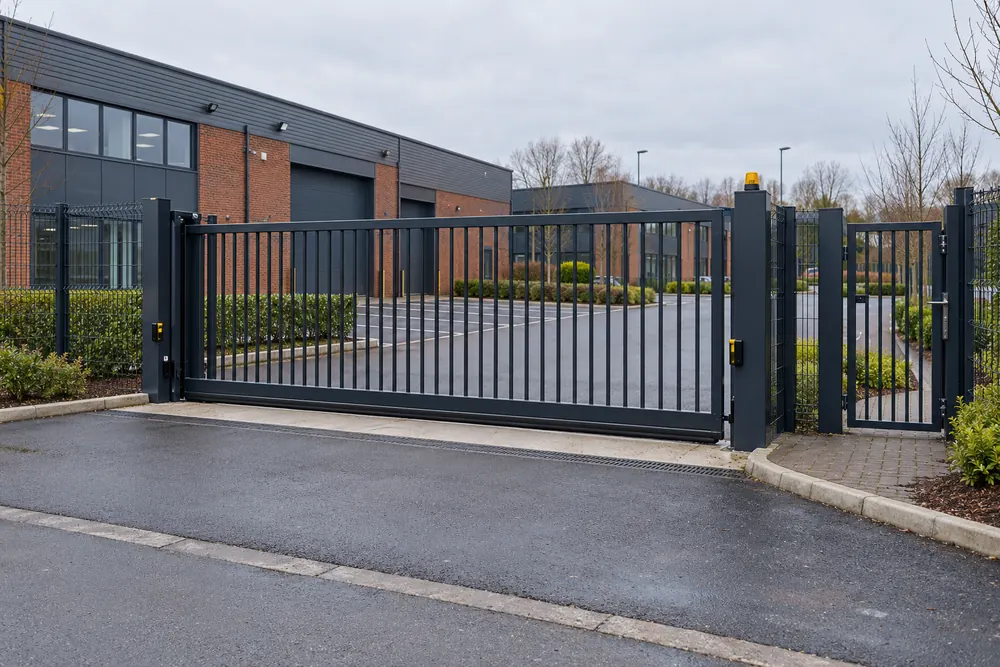
Commercial Gates Need A Site Assessment
Automatic gates in Leicester can control vehicle access to business yards, commercial estates and managed premises. The starting point is the movement of vehicles and people, not the choice of motor. A gate that suits a quiet office car park may not suit a busy loading yard.
We help define the entrance brief, including opening width, traffic pattern, waiting space and visitor controls. Consider deliveries, large turning vehicles and occasions when traffic arrives in both directions. The design should explain how pedestrians reach the premises without depending on the vehicle opening.
Existing gates need a condition check before automation is proposed. Hinges, foundations, posts and supporting structures must suit the intended operation. Adding a motor to a weak gate does not make it suitable for repeated powered use.
Sliding, Swing And Access Options
Sliding gates need space alongside the opening and suitable support or track arrangements. Swing gates need a safe movement area that vehicles and people cannot casually occupy. Ground levels, drainage, wind exposure and underground services can all affect the practical choice.
Vehicle admission may use fobs, an intercom, a staffed release control or other suitable access technology. Agree how visitors are verified and how delivery vehicles leave the site. Unrestricted exit controls can create security weaknesses if their position is not considered carefully.
Decide what happens during power loss or a fault. Staff who may need to use a manual release must know where it is and how it works. Emergency access requirements should be agreed with the premises management before the installation is commissioned.
Powered Gate Safety Comes First
Powered gates can create crushing, shearing, drawing-in and trapping hazards. HSE guidance calls for a risk assessment of the complete installation and suitable protective measures. Safety cannot be assessed solely by looking at whether a gate opens and closes.
BS EN 12453 addresses safety in use of power-operated doors and gates. HSE explains that standards support the safety assessment, but meeting a force limit alone may not address every hazard. Protective edges, guarding, detection and safe clearances need to be considered for the actual installation.
Read the HSE powered gate safety guidance when setting the scope. Ask the installer to explain the applicable machinery requirements, conformity documentation and workplace duties for your project. Do not assume a previous installation date removes the need to deal with an unsafe condition.
From Entrance Survey To Safe Handover
First, inspect the entrance and map vehicle routes, pedestrian movement and potential trapping points. Check available space, structure, ground conditions and power. Agree a safe alternative access arrangement while the entrance is being worked on.
Next, specify the gate, controls and protective measures as one installation. Installation should include the relevant safety checks and documented testing, including force measurements where required. The inspection should cover the whole movement area, not only the leading edge.
At handover, request operating instructions, maintenance requirements and the relevant conformity documents. Demonstrate normal use, the manual release and fault reporting to the people responsible for the premises. If a safety defect is found, the gate may need to be taken out of use until it is made safe.
Budgeting For More Than The Gate
Cost depends on the gate design, supporting structure, groundworks, power route, control method and safety measures. A replacement motor and a complete new entrance are different projects. Difficult drainage, damaged foundations or changes to the vehicle route can affect the scope significantly.
Ask the quotation to separate mechanical work, automation, civil works, access controls and ongoing maintenance. Confirm which party provides electrical supplies and any permissions needed for boundary or highway-related work. Clarify how maintenance visits and safety defects will be handled after installation.
Visitor calls can be considered alongside commercial intercom systems. For recorded entrance coverage, discuss commercial CCTV as a separate recording requirement. Share the entrance layout, gate condition and vehicle use through our project enquiry form.
Your Questions, Answered
Can Our Existing Gates Be Automated?
Existing gates can be automated only if the complete installation is suitable after assessment. The gate leaves, supports, movement area and proposed safety measures all need review. Worn hinges, weak posts or unsafe pedestrian routes may require changes before automation is appropriate, and the final powered installation needs documented commissioning and handover.
Are Photocells Enough To Make A Gate Safe?
Gate photocells alone may not address all the hazards of a powered entrance. Their detection zone can leave crushing, shearing or trapping points unprotected. A competent assessment should consider the entire gate movement, clearances, protective edges, guarding and control arrangements, supported by the testing appropriate to that installation.
Do Automatic Gates Need Maintenance?
Automatic gates need maintenance appropriate to their design, use and environment. The responsible premises manager should follow the supplied instructions, keep records and report damaged safety devices or unusual movement promptly. A gate with a safety defect may need to be isolated until repaired, rather than left operating because it still opens.