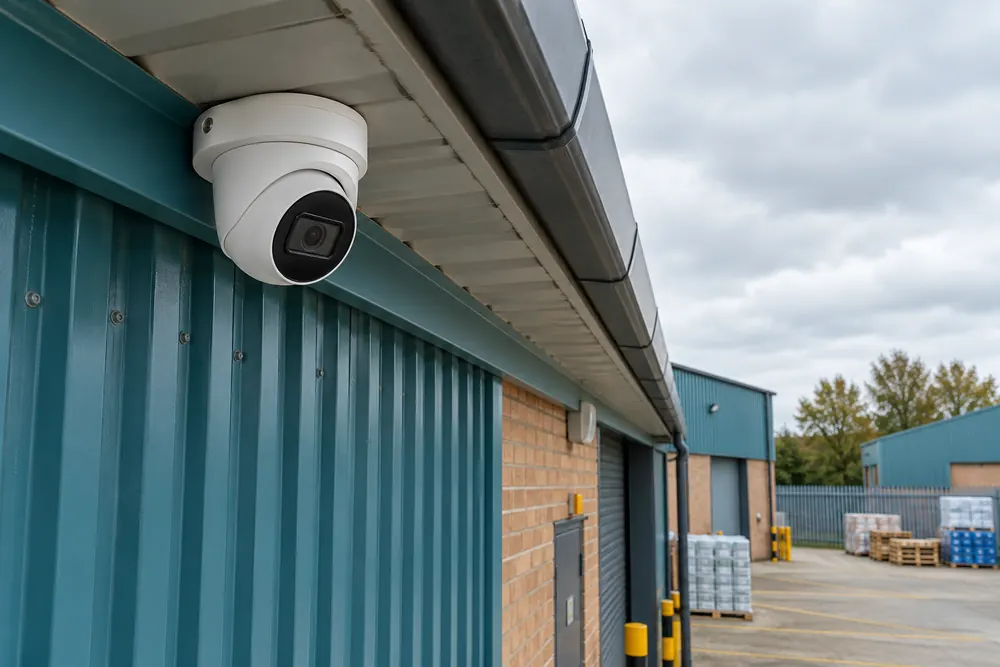
A Camera Plan With A Clear Purpose
Commercial CCTV installation in Leicester starts with the question your footage needs to answer. Do you need to identify someone at a reception door, understand an incident in a loading bay or observe activity across a yard? Those tasks call for different views and camera positions.
We help turn a list of concerns into an installation brief for offices, factories, schools and commercial landlords. A camera count is useful for budgeting, but it is not a design. The required scene detail, lighting and recording arrangements should come first.
Walk the site at the times that matter to your operation. A doorway that looks clear at midday can become difficult to record when backlit, while a yard may have very different lighting after the last shift. Discuss those conditions before choosing equipment.
Coverage, Recording And Network Design
A wide view can show movement without capturing enough detail for identification. Narrower views may be needed at defined entry points. Camera placement should consider vehicle headlights, reflections, obstructions, seasonal planting and the height at which a face or vehicle passes.
IP cameras commonly connect to a network recorder through structured cabling and suitable network switches. Existing analogue cabling may be reusable in some upgrades, but its condition and compatibility need checking. Recording capacity should be calculated from the agreed image settings and retention policy.
Remote access requires careful account management. Agree named users, strong authentication, update responsibilities and how access is removed when a manager leaves. Avoid relying on an installer’s personal account as the only route into the system.
Data Protection And Application Guidance
Business CCTV that records identifiable people engages UK data protection requirements. GOV.UK directs commercial premises to ICO guidance, including information about signs and handling recordings. Read the government’s commercial CCTV guidance when planning your responsibilities.
The premises controller should define the recording purpose, assess whether the coverage is proportionate and restrict access to footage. Consider privacy masking where neighbouring spaces would otherwise enter the view. Audio recording needs a separate justification and should not be enabled simply because a camera supports it.
BS EN IEC 62676-4 covers application guidelines for video surveillance systems used in security applications. It is a design reference rather than a substitute for data protection obligations. The BSI alarm and warning systems catalogue lists the published application guidance.
How Installation Is Planned
First, map the operational requirements and mark proposed views on a plan. Identify working-at-height needs, internal access restrictions and any areas where cameras cannot be installed. Obtain permission for landlord-controlled walls or shared cable routes before work starts.
Next, agree the recording location, network arrangements and installation sequence. Cabling should be supported and protected for its environment. Camera brackets, external joints and power supplies must suit the mounting surface and exposure rather than being selected only for appearance.
Commissioning should demonstrate live and recorded images, time settings, playback and a test export. Check that a manager can retrieve a useful clip without guessing the procedure. Handover should identify who maintains the equipment and who controls the accounts.
Cost Factors And Future Changes
The quotation depends on the required views, installation access, cable distances and recording design. External yards, poor lighting and restricted working hours can add complexity. A low camera price may tell you little about the cost of a complete working installation.
Ask whether storage, network switches, signage, remote access setup and training are included. Separate any recurring licence or cloud storage fees from the installation total. Agree the limits of any integration with your existing alarm or access platform.
Existing cameras that have become unreliable may need CCTV maintenance before replacement is considered. Entrance security can also benefit from managed door access. Send your postcode, business type and coverage concerns through our commercial enquiry form.
Your Questions, Answered
How Many CCTV Cameras Does A Business Need?
The number of CCTV cameras a business needs depends on its recording objectives and the layout of the premises. A wide overview does a different job from an identification view at a door. A survey should map those tasks, check lighting and obstructions, then explain why each proposed camera position is needed.
Can CCTV Be Viewed Away From The Premises?
CCTV can often be viewed remotely through a suitable secured connection and authorised user account. Remote access depends on the recorder, network configuration and available service. Agree who can view or export images, use strong authentication and confirm any subscription charges before including remote viewing in the specification.
Is A High Resolution Camera Always Better?
A high resolution CCTV camera is useful only when its lens, position and lighting capture the detail required. More pixels do not fix glare, an obstructed view or a camera mounted too far from its target. Ask for a demonstration of the intended scene and a recorded clip at handover.